
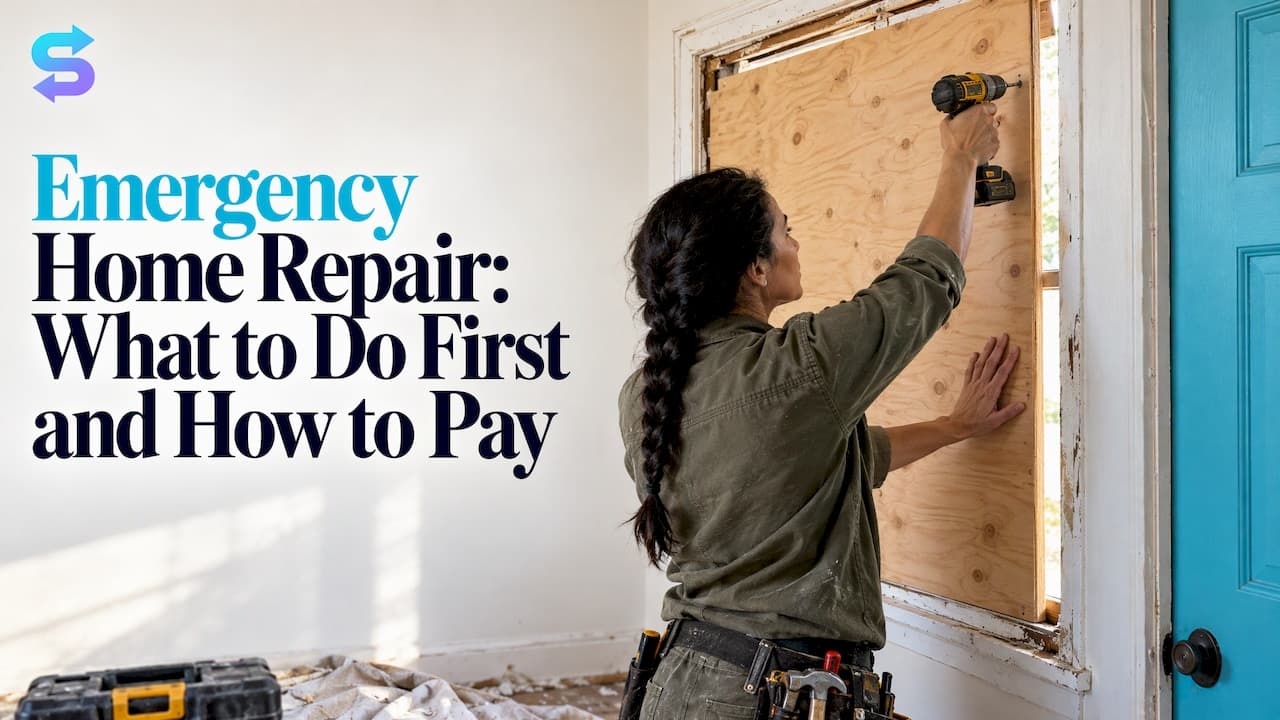
An emergency home repair is any problem where waiting makes it dangerous or much more expensive: a gas leak, active water intrusion, an electrical hazard, a failed heating system in extreme weather, or structural damage. Make everyone safe first, stop the source if you can do it safely, photograph the damage, and then call the right professional. Money questions, such as insurance, assistance programs and financing, come right after that, and this guide covers all of it in order.
TL;DR
- Gas smell, fire, smoke or a carbon monoxide alarm: get everyone out and call 911 from a safe place. Do not stop to fix anything.
- For water, shut off the main supply. For electrical trouble, cut power at the breaker. For structural worries, keep people away.
- Take photos or video before you move things, and report the loss to your insurer. Make only the temporary repairs needed to prevent more damage.
- Help with cost may come from insurance, FEMA after a declared disaster, USDA, local grant programs, or financing such as a HELOC or a home improvement loan.
- Hire a local, verified pro, get more than one bid when time allows, and keep every receipt.
Table of Contents
- What counts as an emergency home repair
- The first minutes: what to do for each type of emergency
- Document everything before you fix anything
- Does homeowners insurance cover emergency repairs?
- Getting help paying for emergency repairs
- Hiring a pro when time is short
- Find a verified home repair pro with SkillSwap
- A short plan for the next 48 hours
- FAQ
- Sources
What counts as an emergency home repair
The simplest test is time. According to Professional Inspection Network, emergency repairs are conditions where delay makes the situation materially worse: active water intrusion, compromised structural integrity, failed mechanical systems in extreme weather, gas leaks, or electrical hazards. Their rule of thumb is that if ignoring the problem for 48 hours would make it significantly worse, treat it as an emergency.
Property managers use a similar list. Buildium names these as emergency maintenance:
- No heat in cold weather, or no air conditioning in extreme heat
- Major plumbing leaks, burst pipes and sewer backups
- Complete loss of electricity
- Gas leaks
- Security problems, such as a broken exterior door lock
- Fire or smoke
- Structural damage, such as a collapsing ceiling or wall
What usually is not an emergency: a dripping faucet you can close off, a single dead outlet with no burning smell, a cosmetic crack, a worn shingle with no leak. These can wait for a scheduled visit, though they are worth fixing before they become urgent.
Why water ranks first
Water does the most damage, and it does it quietly. Professional Inspection Network notes that a leaking roof can saturate insulation, framing and drywall with every rain, creating conditions for mold within 24 to 48 hours. A burst or leaking pipe needs attention the moment you find it: shut off the main water supply, then call a plumber. The longer water runs behind a wall or under a floor, the more structural damage builds and the more costly the cleanup.

The first minutes: what to do for each type of emergency
Your first job is protecting people. Your second is stopping the source, but only if you can do that without putting yourself at risk. A short checklist from Daily Repair follows the same order: protect people, stop the source if safe, document before moving too much, limit secondary damage, then decide between a DIY stopgap, a same-day repair call or a licensed technician.
| Situation | Do this first | Then |
|---|---|---|
| Gas smell, fire, smoke, or CO alarm | Get everyone out and call 911 from a safe location (AHA Home Emergency Center) | Call your gas company from outside. Do not operate switches or devices (Professional Inspection Network) |
| Burst or leaking pipe | Shut off the main water supply | Call a plumber, photograph the damage |
| Electrical hazard | Cut power at the breaker | Call a licensed electrician |
| Structural concern | Keep people away from the affected area | Call a structural pro or your insurer |
| Flooded basement | Do not enter if outlets or cords are underwater; turn off power at the panel | Turn off the gas furnace or water heater, or contact the gas company |
| Tree strike | Check that everyone is unharmed; if lines are down, call your utility | Survey roof, windows, siding and walls |
The flooded-basement and tree-strike steps come from Consumer Reports. It adds that you can vacuum up a few inches of water with a wet/dry vac, and that FEMA recommends shutting off individual circuits first when you cut power. For a tree impact, the Insurance Institute for Business and Home Safety meteorologist quoted there advises contacting a professional if damage is extensive.
When the power is involved
Electrical problems are the ones people most often try to handle alone, and the ones that most often go wrong. If you smell burning, see scorch marks, or have lost power to a whole house, cut power at the breaker and bring in a licensed pro. Our guide to finding and hiring an electrical repair service walks through what to ask and what to expect.
Temporary fixes that are worth doing
Temporary repairs are meant to stop further damage, not to finish the job. Typical examples named by the Kansas Insurance Department are boarding up broken windows, placing plastic over a leaking roof and drying out wet carpets. Leave the permanent work for after you have talked to your insurer and a qualified contractor.
Document everything before you fix anything
Photos and receipts decide how smoothly a claim goes, and they cost nothing. Take pictures or video of the damage before you move items or start any work, and again after emergency repairs. The North Carolina Department of Insurance tells homeowners to keep all receipts and photograph damage before and after emergency repairs, and the Consumer Financial Protection Bureau gives the same advice.
A simple routine:
- Photograph and video every affected room, wide shots first, then close-ups.
- Write down the time you noticed the problem and what you did.
- Save the receipts for materials, hotel stays and any pro who comes out.
- Keep damaged items, if safe, until the adjuster has seen them.
Does homeowners insurance cover emergency repairs?
Sometimes, depending on the cause of the damage and your policy. The rules come from your state and your insurer, so read your own policy, but the regulators agree on the basics.
- You are expected to limit the damage. North Carolina's insurance department says a policy requires reasonable emergency repairs to prevent further damage to the home and its contents. It also says not to make extensive repairs before the adjuster arrives.
- Temporary repairs are generally fine. The Texas Department of Insurance says temporary repairs right after a disaster are generally OK, but permanent repairs should wait until you talk to your insurance company. It adds that your policy should pay for the materials and labor used for temporary repairs.
- Call early. Kansas advises contacting your agent or company right away, getting instructions from the adjuster before repairing or replacing property, and having a written agreement signed before repairs begin.
How a claim typically moves
Openly describes the process this way: you document the damage, report the claim, an adjuster is assigned to review the facts and inspect, they compare the loss to your policy terms and prepare an estimate, and you receive a written explanation of the coverage decision. Payment depends on whether you have replacement cost or actual cash value coverage, and on your policy limits. Common exclusions include flood damage, earthquake damage and normal wear and tear.

That last point matters. A burst pipe may be covered while a failure from long-term wear may not be, so ask your insurer directly before you assume either way.
Getting help paying for emergency repairs
Cost is where most homeowners stall. There are three layers to check: assistance that does not need repaying, assistance that does, and ordinary financing.
Government and nonprofit programs
- FEMA. After a declared disaster, FEMA can help eligible homeowners pay to make a home safe. Per FEMA's home repair guide, the maximum for fiscal year 2025 is $43,600. Eligibility requires that the home be in a declared disaster area, that you own and live in it most of the year, that a FEMA inspection confirm the damage, and that you have no insurance covering it. Covered repairs include a damaged roof or foundation, mold, HVAC, electrical wiring, wells, septic systems and sewer backup. Start at DisasterAssistance.gov or call (800) 621-3362, as the CFPB advises.
- USDA Section 504. The 504 Home Repair Loan and Grant Program serves very-low-income households. Grants require applicants to be 62 or older. You must own and occupy the home, and household income must not exceed Rural Development very-low income limits.
- Local programs. NerdWallet explains that Community Development Block Grants let municipalities offer emergency repair grants, and that Habitat for Humanity, nonprofits, religious volunteers and community centers can also help. Your city or county housing office is the place to ask first.
Loans for disaster damage
Consumer Action reports that SBA disaster loans can reach up to $40,000 for personal property and up to $200,000 for real property to restore a primary residence, and that SBA borrowers must carry flood insurance for the life of the loan. Those figures are from its fiscal year 2021 summary, so confirm current limits with the SBA before you apply.
Financing when nothing else covers it
NerdWallet lists eight ways to pay: a HELOC, an insurance claim, a credit card, a home improvement loan, contractor financing, a cash-out refinance, community or government assistance and disaster relief. A few details from that guide:
- A 0% APR card typically runs 15 to 18 months and generally requires a credit score of 690 or higher.
- Some home improvement loans, which are unsecured personal loans from banks, credit unions and online lenders, fund the same or next day.
If the repair strains your budget, the CFPB notes that damage to your home does not stop your mortgage obligation, but forbearance or a repayment plan may be possible, depending on who owns or guarantees the loan. Call (855) 411-CFPB (2372) to be connected with a HUD-approved housing counseling agency.
Hiring a pro when time is short
Urgency is exactly when homeowners get rushed into bad deals. The Kansas Insurance Department warns homeowners to be wary of unfamiliar contractors after a disaster, to get more than one bid, to hire a local, reputable contractor, and to check references or the Better Business Bureau before using an out-of-town one. Roofers may also need to be registered, so check your state attorney general's office.
When the situation is truly urgent, you may only have time for a quick check. These are the ones worth making:
- License. Plumbing, electrical and gas work usually require a state or local license. Ask for the number and look it up.
- Reviews from real customers. Look for recent reviews tied to actual jobs.
- A written scope and price. Even a one-page estimate beats a verbal figure. Do not sign anything blank.
- Payment method. Avoid paying the full amount in cash upfront, and keep records for your insurer.
- Permanent versus temporary. Ask the pro which work is a stopgap and which is the final repair, so your adjuster sees the difference.
If you live in Central Arkansas, local home improvement services can take over once the immediate hazard is controlled and you need repairs, replacement windows, doors or siding.
Our view: speed and trust shouldn't be a trade-off
We built SkillSwap around a problem we hear from people all the time: when something breaks, you need someone fast, but you have no way of knowing who is reliable. That is the moment people overpay or hire the wrong person.
Our approach is to remove the guessing. Every provider on our platform goes through identity verification and a background check. Reviews come from previous customers, and each provider has a live trust score, so you can compare people on the same footing before you book.
Price is the other worry. Our Dynamic Pricing Engine™ adjusts costs based on real-time market data, which is designed to keep pricing responsive to what local work actually costs, for the person hiring and the person doing the job. Payments are handled securely through the platform, so you have a record for your insurer.
Our advice is simple: handle the danger first, document it, and then hire someone who has been checked, not the first number that answers a search.
Giannis
Find a verified home repair pro with SkillSwap
Once everyone is safe and the source is stopped, you still need the repair done properly. SkillSwap is an online marketplace that connects you with verified local professionals for home repair, with identity and background verification, authentic customer reviews, a live trust score for every provider and secure payments.

You can post a service request describing the job, see how the process works on our how it works page, and learn how provider ratings are calculated on our reputation score page. For pricing context, our pricing intelligence page explains how our Dynamic Pricing Engine™ works.
A short plan for the next 48 hours
When you are in the middle of a problem, a sequence helps more than a list of tips.
- Hour 0: Get people and pets to safety. Call 911 for gas, fire, smoke or CO.
- Hour 0 to 1: Shut off water, power or gas only if it is safe to reach the shutoff. Photograph everything.
- Hour 1 to 3: Call your insurer. Ask what they need, what temporary repairs they expect and whether you need the adjuster to see the damage first.
- Same day: Line up a licensed pro. Get a written estimate for the temporary stopgap and for the permanent repair.
- Day 1 to 2: Dry out affected areas to slow mold, which can begin within 24 to 48 hours of water intrusion according to Professional Inspection Network. Keep every receipt.
- Day 2 onward: Ask about assistance programs and financing if the cost exceeds what insurance will cover. Start with your city or county housing office.
The point of the sequence is to avoid the two most expensive mistakes: delaying until a small problem becomes a big one, and making permanent repairs before the claim is documented.
FAQ
What is considered an emergency home repair?
Any condition where delay causes real danger or significantly worse damage: gas leaks, active water intrusion, electrical hazards, structural damage, fire or smoke, or a failed heating or cooling system in extreme weather. A common rule of thumb is that if ignoring it for 48 hours would make it much worse, it is an emergency. Anything involving gas, fire or carbon monoxide means leaving the home and calling 911.
Should I make repairs before the insurance adjuster arrives?
Make only the temporary repairs needed to prevent further damage, such as covering a roof with plastic or boarding a window. State insurance departments in Texas, North Carolina and Kansas all advise photographing the damage first, keeping receipts and holding off on permanent work until you have talked to your insurer.
Is there free help for emergency home repairs?
There can be, depending on your income, location and the cause of the damage. Options include city or county emergency repair grants, the USDA Section 504 program for very-low-income owners (grants for those 62 and older), and FEMA assistance in declared disaster areas. Your local housing office is a good first call.
How can I pay if insurance does not cover the repair?
Common routes are a HELOC, a home improvement loan, a 0% APR credit card, contractor financing or a cash-out refinance. Compare the interest rate, fees and repayment terms before you sign. If you are behind on your mortgage because of the repair, a HUD-approved housing counselor can walk you through your options.
How do I avoid contractor scams after storm damage?
Get more than one bid when you can, favor local contractors with verifiable references, and check licensing or registration with your state. Never sign a blank contract. A marketplace with verified identities, background checks and customer reviews gives you a head start on that vetting.
Sources
- Home Emergency Center, AHA
- Don't Wait on These: The Homeowner's Guide to Emergency Home Repairs, Professional Inspection Network
- Property Management Maintenance Emergency Guide, Buildium
- Emergency Home Repair Checklist, Daily Repair
- How to Keep Your Home Safe, Consumer Reports
- Home and Renters Shoppers Guide, Kansas Insurance Department
- Loss Prevention and Aftermath, North Carolina Department of Insurance
- FAQ: Homeowners insurance and disaster claims, Texas Department of Insurance
- How the Home Insurance Claim Process Works, Openly
- Help with Home Repair, FEMA
- 504 Home Repair Loan and Grant Program, USDA Rural Development
- What should I do after a disaster to protect my finances and property, CFPB
- 8 Ways to Pay for Emergency Home Repairs, NerdWallet
- Disaster insurance and FEMA assistance, Consumer Action