
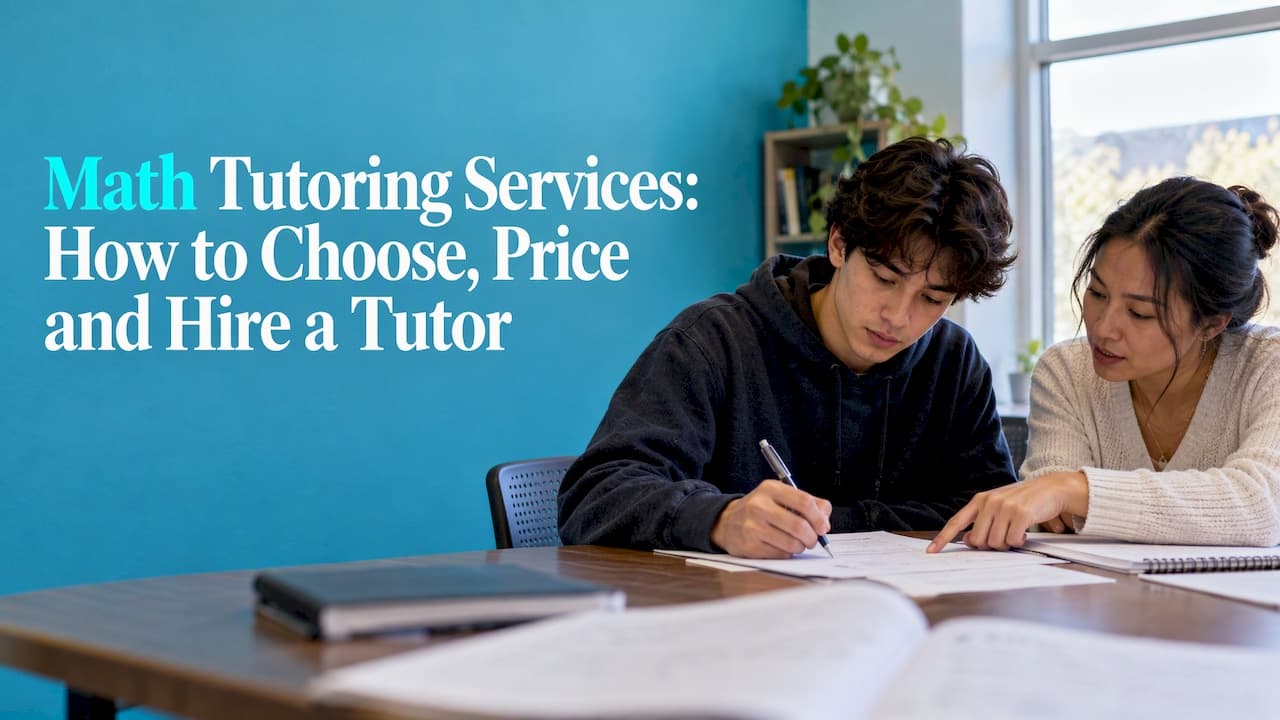
The best math tutoring service is the one that pairs the student with the same qualified tutor every week, at a price you can sustain for at least ten weeks. In the US, private tutoring commonly runs $20 to $70 per hour, and the format (one-on-one, small group, in person or online) matters less than consistency and fit. This guide shows you how to compare your options, what to ask before you book, and how to avoid paying for sessions that don't move the grade.
TL;DR
- Expect roughly $20 to $70 per hour for a private math tutor, with advanced or specialist tutors higher, especially in large metro areas.
- One-on-one tutoring is the most intensive format. Research on high-impact tutoring points to at least three sessions a week for ten weeks with the same tutor.
- In-person and live online tutoring can both work when the student sees the same tutor, often enough, with a well-supported tutor.
- Vet every tutor: ask about training, lesson structure, how progress is measured and how sessions tie to your coursework.
- On SkillSwap you can request a verified local tutor, with background checks, reviews and a live trust score on each provider.
Table of Contents
- What math tutoring services actually include
- What math tutoring costs in the US
- Why one-on-one math tutoring works
- In-person or online math tutoring
- How to vet a math tutor before you book
- Reading, writing and science tutors
- Our perspective on hiring a math tutor
- Find a verified math tutor near you
- A simple plan for your first month
- If you tutor math yourself
- FAQ
- Sources
What math tutoring services actually include
Math tutoring is not one product. The label covers several quite different arrangements, and the price and results depend on which one you pick.
Private tutors work with you directly, usually one-on-one, at your home, a library, a campus study room or online. Training ranges widely, from high school students with strong grades to experienced teachers. A private tutor may reteach specific skills, help you keep up with schoolwork, and sometimes coach organization and time management.
Tutoring companies and learning centers employ tutors, set the curriculum and schedule, and charge a company rate. You get structure, but you often have less say over who teaches you.
Subscription and on-demand platforms offer online sessions or homework help at a flat monthly fee. These suit quick questions better than long-term skill building.
Free help exists too: peer tutors, school or campus tutoring centers and neighborhood programs can be free. They are a good first stop for a single hard unit, and a paid tutor is the next step when you need a steady, personal plan.
Tutoring suits students who are below grade level or need help in a specific area such as math, reading, writing or science. Tutors usually target current academic skills. If a student has persistent academic and social-emotional difficulties, the same source suggests an educational therapist may be the better fit, so mention any learning differences to a tutor up front.

What math tutoring costs in the US
Published price ranges differ by source, region and tutor background. Here are the figures we found, with where they come from.
| Type of help | Typical US range | Source |
|---|---|---|
| Private tutoring, general | $20 to $70 per hour; highly skilled math tutors up to $75 | Reading Rockets |
| Online human tutoring | About $20 to $50 per session | Reading Rockets |
| Subscription tutoring services | Around $100 per month | Reading Rockets |
| Private professional math tutor | $40 to $125 per hour | Prodigy cost guide, 2022 |
| Student tutor | $20 to $50 per hour | Prodigy cost guide, 2022 |
| Online private tutor | $20 to $100 per hour | Prodigy cost guide, 2022 |
| Online group tutoring | $15 to $75 per hour | Prodigy cost guide, 2022 |
| Tutoring company | $30 to $85 per hour | Prodigy cost guide, 2022 |
The Prodigy figures were published in 2022, so treat them as a baseline and expect current local quotes to differ. Another source reports that private tutors in many states average around $40 an hour, while highly skilled tutors in metropolitan areas may charge $150 or more.
What moves the price
- Level of math. Algebra 1 help costs less than calculus, linear algebra or statistics for a graduate course.
- Tutor background. A fellow student, a retired teacher and a working engineer price very differently.
- Location and format. Big metro areas cost more. Online widens the pool and can lower costs.
- Frequency. Weekly sessions over a term cost more in total than a one-off exam cram, but they are the pattern research favors.
Is $50 an hour too much?
It falls inside the ranges above, so it is not unusual. The better question is what you get for it. A $50 hour with a tutor who diagnoses your gaps, assigns targeted practice and checks progress each week is worth more than a $25 hour of homework answers you can't reproduce on an exam. Before you decide, calculate the cost of a full ten-week block rather than a single hour.
Why one-on-one math tutoring works
One-on-one tutoring (some people search for it as face-to-face tutoring) means a single tutor and a single student, adjusting every explanation to what that student does and doesn't understand. There is solid evidence behind the format.
A meta-analysis of experimental studies in preK-12 found a pooled learning effect of 0.37 standard deviations from tutoring. The same review found stronger average effects for teacher and paraprofessional tutors than for nonprofessional or parent tutors, and effects were generally strongest in earlier grades.
Researchers describe high-impact tutoring as individualized, relationship-based instruction, delivered one-to-one or in groups of up to three students. The same brief says it should happen at least three times a week for a minimum of ten weeks. It also notes that one-to-one tutoring is highly effective but costs more and serves fewer students.
What does that mean for your budget? If you can't afford three sessions a week, don't give up on tutoring. Consider these options:
- Shorter, more frequent sessions rather than one long weekly session.
- A small group of two or three students with the same tutor, splitting the rate.
- One paid session per week, plus structured practice between sessions that the tutor assigns.
The research benchmark is a target to aim for, not a promise that a lesser schedule is useless.
In-person or online math tutoring
Most tutoring research has focused on in-person programs, which have shown the greatest achievement impacts. Emerging evidence indicates that live virtual or blended tutoring can also be effective, and that it can lower costs and expand the tutor pool.
Stanford's National Student Support Accelerator says both formats can be high-impact when students see the same tutor, the tutor is well supported, and sessions are frequent enough. It also notes that in-person tutoring may make relationship-building and understanding the school context easier, while online tutoring can broaden the pool for scarce skills such as advanced math.
| In-person | Online | |
|---|---|---|
| Best for | Younger students, students who lose focus on screens, hands-on work with paper and manipulatives | Advanced courses, tight schedules, rural areas, students who prefer a whiteboard and screen share |
| Relationship | Often easier to build | Works well with the same tutor every week |
| Tutor pool | Limited to your area | Much wider |
| Cost | Can be higher, with travel time | Often lower per session |
If you search for in-person tutoring because you work better face to face, start with local tutors. A local tutor can meet at a library, a campus study room or your home, and can see your handwritten work as you go. If your schedule is tight or you need a specialist in an advanced course, live online may be the better pick.
How to vet a math tutor before you book
Qualifications are only part of it. Here are the questions we recommend asking, adapted from guidance on evaluating tutoring programs.
- Training and background. What math have they studied or taught? Have they tutored this specific course before?
- Lesson structure. What does a typical session look like? Is there a plan, or do you just work through homework?
- Frequency. How many sessions a week do they recommend, and why?
- Progress checks. How will they assess whether you are improving, and how will you see it?
- Alignment with your class. Will they work from your syllabus, textbook and past tests?
- Fit to your needs. Can they explain how they would address your specific gaps?
The same guidance says a child's teacher can suggest tutors. For a student, your instructor or a campus tutoring center can often point you to someone who knows your course.
Run a trial session
Book one session before committing to a block. Bring your last graded test and ask the tutor to find the pattern in your mistakes. A good tutor will name specific skills (fraction operations, factoring, limits) rather than telling you to "practice more." Then notice whether you could solve a similar problem on your own by the end of the hour.
Safety and trust
When a tutor works with a minor, or meets you at home, verification matters. Look for confirmed identity, a background check and genuine reviews from previous clients, and meet in a public place for first sessions when you can. Pay through the platform rather than in cash, so there is a record of every booking.
Reading, writing and science tutors
Many readers who search for math help also need other subjects. The same principles apply: same tutor, regular sessions, clear goals.
Writing tutors help students plan, draft, organize, revise, edit and proofread, and may teach grammar, punctuation, sentence construction and text structure. Writing is a process, not a one-draft product, so look for a tutor who reviews drafts with you rather than rewriting them. Writing about what you read can also strengthen reading comprehension.
Reading tutors provide one-to-one instruction and practice. Effective programs use research-based lesson plans, regular assessment and materials at the student's reading level. The same source recommends that students generally be tutored at least twice weekly for 45 to 60 minutes, with some needing more. For early readers, the federal What Works Clearinghouse describes one program as daily 30-minute one-to-one tutoring for first graders over 12 to 20 weeks.
Science tutors follow the math pattern: look for someone who has taught your exact course and who explains problem-solving steps, not just answers.
Our perspective on hiring a math tutor
At SkillSwap, we think the hardest part of hiring a tutor isn't finding a name. It's knowing who to trust and whether the price is fair.
That is why every provider on our platform goes through identity verification and background checks, and why each one carries a live trust score and reviews from real previous clients. You should be able to see who you are inviting into your home or onto your screen before you book.
On price, our Dynamic Pricing Engine™ is designed to reflect real-time market data, so rates respond to what comparable services actually cost rather than to guesswork. For students on a budget, that transparency is meant to make it easier to judge a quote. For tutors, it is designed to help them price their time well.
Our advice: choose a tutor you can keep for a full term, ask the vetting questions above, and treat the first session as a test. A good fit beats a famous brand.
Giannis
Find a verified math tutor near you
If you are in Bergen County, NJ or nearby, SkillSwap connects you with local professionals for tutoring and lessons, along with cooking, fitness, music, home repair and beauty services. Describe what you need, and we help you find a verified provider rather than leaving you to sift through unvetted listings.

Ready to start? Submit a service request and tell us the course, the level and your schedule. Want to see how matching, payments and verification work first? Read how SkillSwap works, look at how our trust score for providers is shown, or see how pricing intelligence informs the rates you see.
A simple plan for your first month
Here is a practical way to put all this together without overspending.
Week 1: Diagnose. Gather your last two graded tests or quizzes. Pick two or three candidate tutors, check their reviews and verification, and book a trial session with the strongest one.

Week 2: Commit to a block. If the trial went well, agree on a schedule. Aim for the highest frequency your budget allows, ideally two to three shorter sessions a week. Ask the tutor to write down three specific goals, such as "solve two-step equations without errors."
Weeks 3 and 4: Practice between sessions. Do the assigned problems before each meeting so lesson time goes to new ideas, not to catching up. Keep a list of questions as they come up.
End of month: Check progress. Compare a new quiz or practice test to the earlier ones. If the pattern of errors hasn't changed, tell the tutor and adjust the plan, or switch tutors.
A worked example
Say a tutor quotes $40 an hour. Two one-hour sessions a week for ten weeks is 20 hours, or $800. Three 45-minute sessions a week for ten weeks is 22.5 hours, or $900. Splitting that second plan with one other student cuts each share to $450. Run the numbers for your own quote before you decide, then compare to the ranges in the table above.
If you tutor math yourself
Many college students, freelancers and gig workers tutor on the side. If that's you, a marketplace can handle the hard parts: finding clients, verifying yourself so families trust you, and collecting payment securely. SkillSwap lets providers build a reputation through reviews and a live trust score, and our earnings page explains how providers can track what they make.
FAQ
What do people charge for math tutoring?
Most private tutoring falls between $20 and $70 per hour, with highly skilled math tutors reaching about $75. A 2022 cost guide put private professional math tutors at $40 to $125 per hour. Metropolitan areas and advanced subjects can cost more.
How often should a student meet with a math tutor?
Researchers define high-impact tutoring as at least three sessions a week for ten weeks. If that isn't realistic, shorter sessions twice a week or a small group can still help. Discuss the right pace with the tutor after a trial session.
Is online math tutoring as good as in-person?
It can be. Stanford researchers say both formats can be high-impact when students see the same tutor, the tutor is well supported and sessions are frequent. Online widens your choice of tutors, especially for advanced math, while in-person can make building rapport easier.
How do I hire a math tutor I can trust?
Check identity verification, background checks and reviews from real clients. Then ask about training, lesson structure, progress checks and how they will work with your course. Start with one trial session before you commit to a block.
When might a tutor not be enough?
Tutors usually target current academic skills. If a student has persistent academic and social-emotional difficulties, an educational therapist may be a better fit. Talk with the student's teacher or school about next steps.
Sources
- A Guide for Finding a Tutor, Reading Rockets
- Average Rates & Pricing for Math Tutoring in 2022, Prodigy
- The difference between tutors and educational therapists, Understood
- Design Principles for Accelerating Student Learning with High-Impact Tutoring, EdResearch for Action
- The Impressive Effects of Tutoring on PreK-12 Learning, NBER
- Types of Tutoring: Effectiveness and Equity, National Student Support Accelerator
- Teachers' Guide, Reading Rockets
- Writing to Read, Reading Rockets
- Helping Your Child: Guidance for Families, Reading Rockets
- Reading Recovery Intervention Report, Institute of Education Sciences